
Can Eswatini Produce a Unicorn? (1 of 4)
June 27, 2023
Possible Funding Options for Startups
July 21, 2023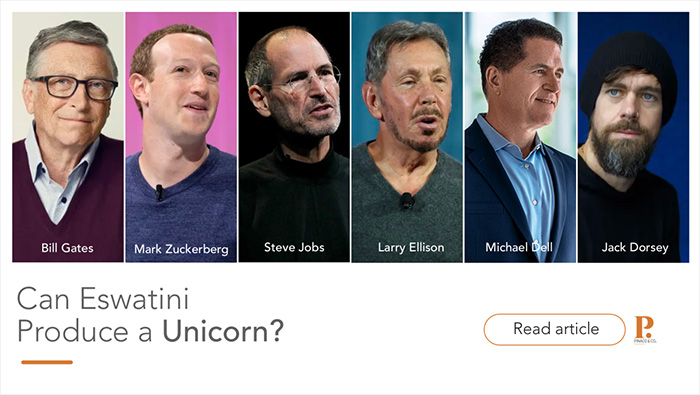
Bill Gates, Mark Zuckerberg, Steve Jobs, Larry Ellison, Michael Dell and Jack Dorsey. Do these names sound familiar and what’s common about them? Well, first they are males and secondly, male billionaires. Thirdly, they all dropped out of college to start billion-dollar companies or as we now know, unicorns. But didn’t Nelson Mandela say, “Education is the most powerful weapon which you can use to change the world?” Yes, he did but there is something bigger than education – vision.
What has put the six in the top 1% of successful entrepreneurs in the world is their vision which was so big that a college certificate could wait and to some, waived. Mark Zuckerberg who founded Facebook, dropped out of the world’s top university, Harvard University, after enrolling for two years. Why? He had found three valuable assets; a billion-dollar idea, vision and the minimum education he needed to achieve both. Vusi Thembekwayo recently wrote, “Education becomes relevant when you know what to do with it.”

In part one of this series, “Can Eswatini produce a unicorn?” I shared questions (I call #Ian’sBig4) that keep me up at night; how do we attract venture capital into Eswatini to create jobs for the youth? How do we accelerate start-up ecosystem development in Eswatini? How do we develop the skills required to achieve a private sector-led economy? Lastly, can Eswatini produce a unicorn?” Whilst I believe that a unicorn is possible for Eswatini by the turn of this century, this cannot happen without private equity funding, robust domestic financial markets that will see our start-ups going public in an IPO and most importantly – grand visions.
There is a secret I have kept from my family for a decade. It is important that I share it with you to illustrate the intensity and burden of an entrepreneurial vision. Back in 2012, I had the same drive, determination, and vision that the six mentioned entrepreneurs had to a point where I had thoughts of dropping out of university to pursue my dream of building the “next big thing”.
Besides studying towards my first degree, writing as columnist in my country’s leading newspaper – Times of Swaziland SUNDAY, preparing for an entrepreneurship competition (Enactus World Cup) in Washington DC, USA, where my team later won gold medals, I was building a start-up which now had 15 team members and 5 shareholders. It made sense to drop out of university, right? Wrong!
Whilst I’m not proud of what I’m about to tell you, I now understand why I did it. In an exam paper for one university course, Economics for Journalists taught by Dr. Adidi Uyo, there were four questions, and we were required to choose two. I did not answer any of the questions in the exam paper but instead decided to add my own, “How can African achieve economic prosperity?”
Whilst my classmates were studying for the economics exam paper the previous day, I was studying the economies of the US, Japan and China – how they were built. Answering my exam question, I wrote about how Japan’s economy experienced rapid growth in the decades following World War II, a period known as the Japanese economic miracle. I explained how China’s economy grew at an average annual rate of over 9% for the past four decades and the contribution of the billionaire entrepreneurs to the US economy. I concluded by sharing my ideas on how Africa can become equally successful.
Now, you will agree with me – I was wrong on many fronts; I studied the wrong “syllabus”, failed to follow exam instructions by crafting my own exam question, used the wrong platform and timing to communicate my ideas, and obviously failed the course. That’s better than dropping out, don’t you think? I think so too.
Here’s what I did right though – I believed in my entrepreneurial vision to a point where I was prepared to fail an exam to communicate it. I did not end there, I captured my vision in an unpublished book I titled, “The New Hope for Africa Tomorrow”. The vision was intense then as it is now. In part three of this series, I will share with you how my university-born business eventually failed, how my lawyer took advantage of us, how I lost all the capital my dad gave me, the debts I incurred; the death threats I got to a point of seeking police protection, how my late dad took a ‘bullet’ for me and how I eventually paid of the debts.

Thousands of entrepreneurs across the world have similar stories. But you know what inspires me never to let go of my vision? Dr. Myles Munroe’s quote; “Every human being was created to accomplish something that no one else can accomplish” GYM, the start-up I co-founded in university failed but the vision has not failed because no one in this world can accomplish it besides me.
Are you familiar with the words, “the vision is yet for an appointed time; but at the end it will speak, and it will not lie. Though it tarries, wait for it; because it will surely come, it will not tarry?” If you aren’t, google them to get the context.
Then, I believed as I do now, that Eswatini can produce a unicorn. Pinaco & Co (GYM 2.0) is on a mission to discover and present to the world Eswatini’s first unicorn. We are building Eswatini’s largest start-up database powered by AI that will be a source of key data that will drive and attract venture capital into the start-up economy in Eswatini – the type of funding our first unicorn needs. “AI will add US$30Tn to the global GDP by 2030,” a senior Microsoft executive told Strive Masiyiwa.
Our one-month-old start-up database, called Pinaco & Co. Start-up Hub, is already showing great insights about our start-up ecosystem. Of the 21 start-ups registered in our Start-up Hub as of 10 July 2023, 81% of the founders are males with 57% operating their start-ups from home and 71% of them citing innovation as their competitive advantage. About 90% of the start-ups were established between 2021-2023 and the dominant sector is Agriculture at 33%, followed by manufacturing at 23%.
Another key finding is that 67% of the start-ups are financed through personal investments, 22% through business loans, and 11% from grants. On annual turnover, 66.7% make between E10,000 and 50,000 annually and only 11% of the start-ups make an annual revenue of E400,000 and above.
What we are also seeing is that 38% require capital of between E50,000 and E100,000, 14% require between E300,000 and E500,000 whilst 9.5% of them do not require capital. Only 5% of the start-ups require capital of E5 million and above. The need to connect Eswatini to private capital ecosystems is increasingly becoming important in accelerating the growth of our start-ups.
Pinaco & Co. is poised to become source of information, insights, and intelligence inspiring investor confidence in our start-up ecosystem. Through the Start-up Hub and the Eswatini Start-up Ecosystem Report, Pinaco & Co. is on a mission to enable Eswatini to contribute to global data metrics on the Eswatini start-up ecosystem, thereby creating basis for a global investment case for Eswatini. We are toiling the ground for Eswatini’s first unicorn, and we need all Eswatini start-ups to register on our Start-up Hub.
I like to think of myself as a start-up ecosystem developer with a dream of seeing Eswatini launch its first unicorn. If you are one of the people bothered by #Ian’sBig4 questions, let’s talk. To VCs with appetite for the hashtag#Eswatini market, let’s engage.
hashtag#JobsMatter hashtag#AfricaMatters hashtag#EswatiniMattersMore.